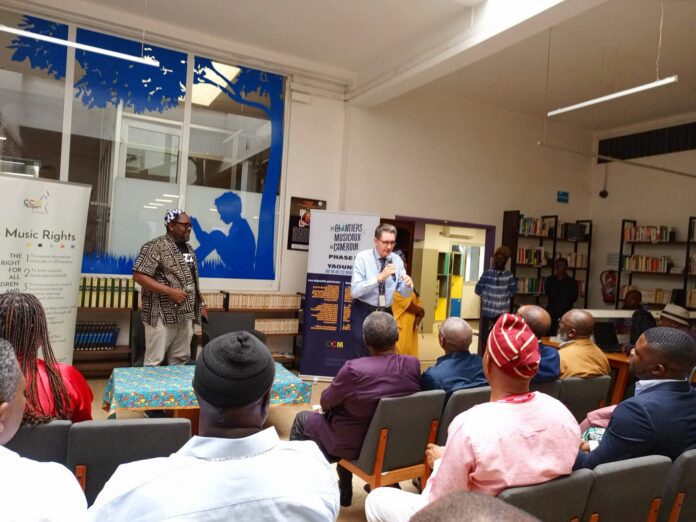
The Cameroonian music sector has just crossed an additional level in its race for professionalization. The Cameroon Music Council has drawn up a roadmap for industrialization of the sector. This is achieved through the initiative entitled: « The Musical Buildings of Cameroon ». A concept that took place in three distinct stages, from February to June 2024.
The first phase provided an accurate overview of the Cameroonian music industry, drawing on the expertise of some 60 professionals from the country's ten regions. This phase also identified the most structured players in the sector. The second phase was capacity-building for some 30 of these key actors through training and skills-building workshops. These workshops, held on the sidelines of the Yaoundé Music Expo (Yamex), enabled participants to acquire technical and methodological tools to better manage their activities and contribute to structuring the sector. The third and final phase was devoted to drafting a « Development plan for the music industry in Cameroon ». This framework document, drawn up by the JCC Scientific Committee, offers an in-depth analysis of the situation of music in Cameroon, as well as concrete solutions for the development of the sector in the short, medium and long term.
The music industry development plan proposed by this organization is a valuable roadmap for the coming years. It will guide investment and public action in the music sector and create an environment conducive to the emergence of internationally renowned Cameroonian talent. In concrete terms, the JCC will be asked to create and structure a network of professionals throughout the country, to contribute to the training and professionalisation of Cameroonian players in music, and finally to implement short-, medium- and long-term objectives of the scheme presented last month to the general public.
ECONOMIC OPPORTUNITIES AND FUTURE PROSPECTS
This JCC initiative takes place in a context where the Cameroonian music industry faces a number of challenges, including the predominant informal. According to the CCM, 89% of music professionals are active in the production of musical works on the national chessboard. On the other hand, only 6% are involved in dissemination, and 5% in promotion, indicates the same source. With more than 15,000 artists, the music industry has considerable economic potential. According to Melwater, a media monitoring platform, Internet statistics for 2024 show a changing digital landscape in Cameroon. With an estimated penetration rate of 43.9%, or 12.73 million Internet users, and 5.05 million social media users, or 17.4% of the total estimated population of more than 28 million. These data promise a considerable dynamic for the music economy, as well as for the streaming industry. Colorfol, a digital platform developed by a Cameroonian start-up, which allows users to access audio and video content promoting African music and independent artists is trying to impose in this market. Other platforms include BoomPlay and Deezer.
According to the Center for the Study of African Economies (CSEA), the contribution of the ICT sector to Cameroon amounts to about 5 per cent of GDP. This demonstrates the potential for further growth through the expansion of its digital infrastructure. Overall, Africa's digital economy is growing, with ambitious projections for the coming decades. By 2025, it could account for 5.2 per cent of the continent's GDP, which is estimated at over $180 billion. In the longer term, by 2050, this figure could reach $712 billion. A prospective study conducted by Dataxis and published in June 2022 also reveals that African music streaming revenues are expected to grow significantly. They are expected to triple over the next five years, from $92.9 million in 2021 to $314.6 million in 2026. This trend reflects the growth of digital music on the African continent.
« Allow the artist to participate in the state tax base »
I will explain why it is necessary for professionals to start businesses. In Cameroon, the legal framework requires that a label producer, for example, when he makes a deal, even if it is punctual, in the case of a concert or a call for tenders from a mobile operator, who tells him: "I need your artist, I will pay you a million CFAF", must know that the label will never receive this money in cash if it exceeds 100,000 CFAF, and this is what the current finance law stipulates. As a company, taxes must be levied on the company and on the profits realized. As a result, they immediately understand what is at stake. We had a workshop on financing musical projects where we had a representative of the world of finance who explained that the artist is disconnected from the economy of culture.
However, he is a taxpayer like all the others, and in respect of a benefit he makes, he is paid. This allows the artist to participate in the state's tax base. This is a bit of the plea that we are going to make to the state. The data reveal that the entire body of the music industry is more than 15,000 souls. Imagine the potential in terms of economic contribution, you just have to frame all this. Today, as a company, to have its Unique Identification Number (NIU). What people don't know is that it's the same constraint for the lambda taxpayer, even me as an individual, I have to have a NIU, because it's now impossible to open a current account without that number. The only difficulty that needs to be overcome in the banking process is when they ask an artist for proof of income. It's complicated because he doesn't have a payroll, he doesn't receive a regular monthly salary and can't provide proof. However, he can guarantee that he is recognized in the corporation as a music professional, so whatever happens, he has income. The banking product must be adapted to the artist's environment.